🌅
Morning in Berbice
The day doesn't start when you wake up. It starts when the pot goes on.
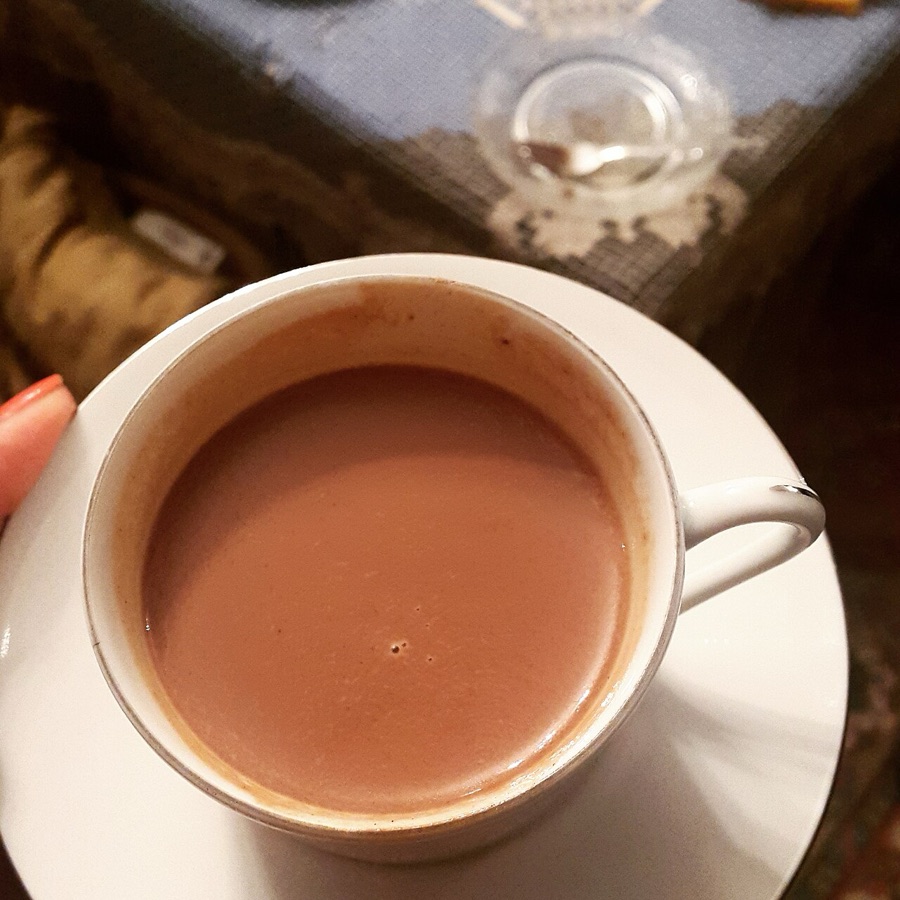
Cocoa tea, held like the morning treasure it is · photo: Emna Mizouni, CC BY-SA 4.0 (Wikimedia Commons)
A Guyanese morning in a cup. If you've only had cocoa from a tin, sit down — this is going to be emotional.
From the Garden & Market
- 1 cocoa stick (grated, about 3 tbsp)
- 3 cups water
- 1 cinnamon stick
- 1 bay leaf
- 1 cup milk (or coconut milk)
- Sugar or condensed milk, to taste
- Tiny pinch of salt & grated nutmeg
The Way Mama Teaches
- Bring the water to a boil with the cinnamon and bay leaf.
- Whisk in the grated cocoa stick and let it simmer gently 10–15 minutes — the oils will rise and the kitchen will smell like heaven.
- Add the milk, sweeten to taste, and warm it back through — don't let it boil over.
- Finish with the pinch of salt and nutmeg. Strain into cups.
Mama says: real cocoa carries a little oil on top — that's not a flaw, that's the blessing. Don't skim it.
For my family: Sunday mornings, before anybody's allowed to be busy.
Milk tea, made proper
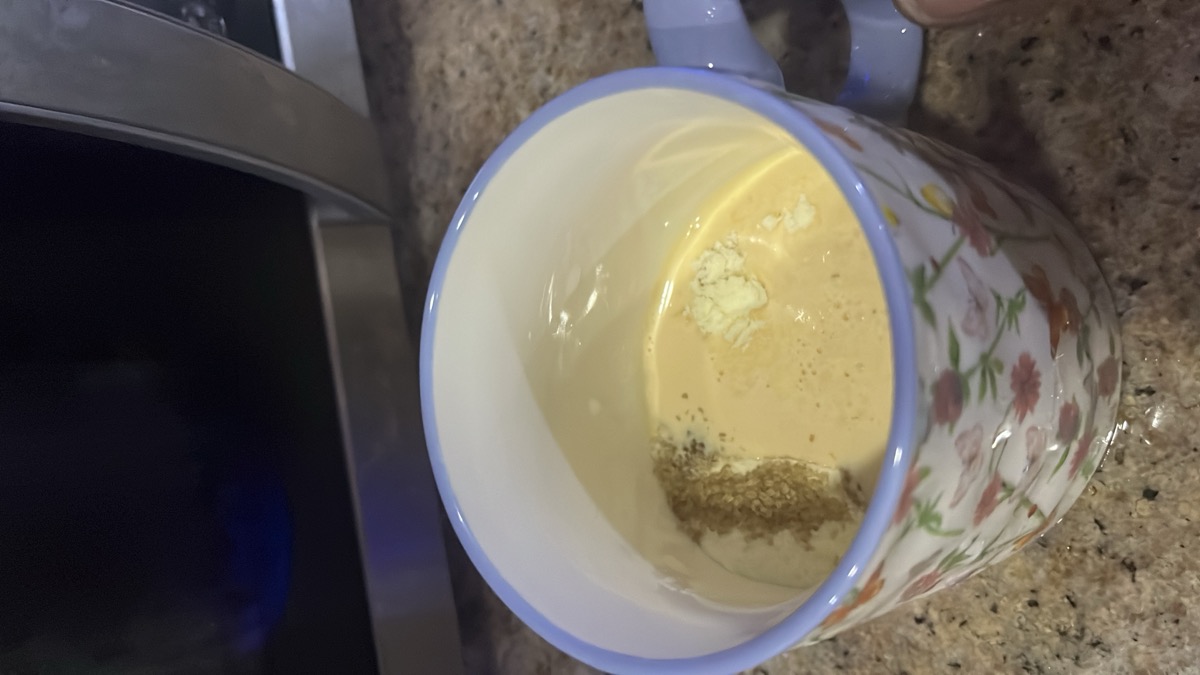
The classic — the way mama poured it. Strong tea, real milk, no shortcuts, no teabag left drowning and forgotten.
From the Garden & Market
- 2 cups water
- 2 black tea bags (or 2 tsp loose tea)
- 1 cup milk
- Sugar or condensed milk, to taste
- Optional: a slice of ginger or a cardamom pod
The Way Mama Teaches
- Boil the water — with the ginger or cardamom if you're feeling special.
- Add the tea and let it steep 3–4 minutes. Strong, not bitter — taste it.
- Warm the milk and pour it in. Sweeten to taste.
- Serve hot, with something to dip if you know what's good for you.
Mama says: the tea steeps for minutes, not the whole morning. Set it, watch it, respect it.
For my family: every single day. This one is non-negotiable.
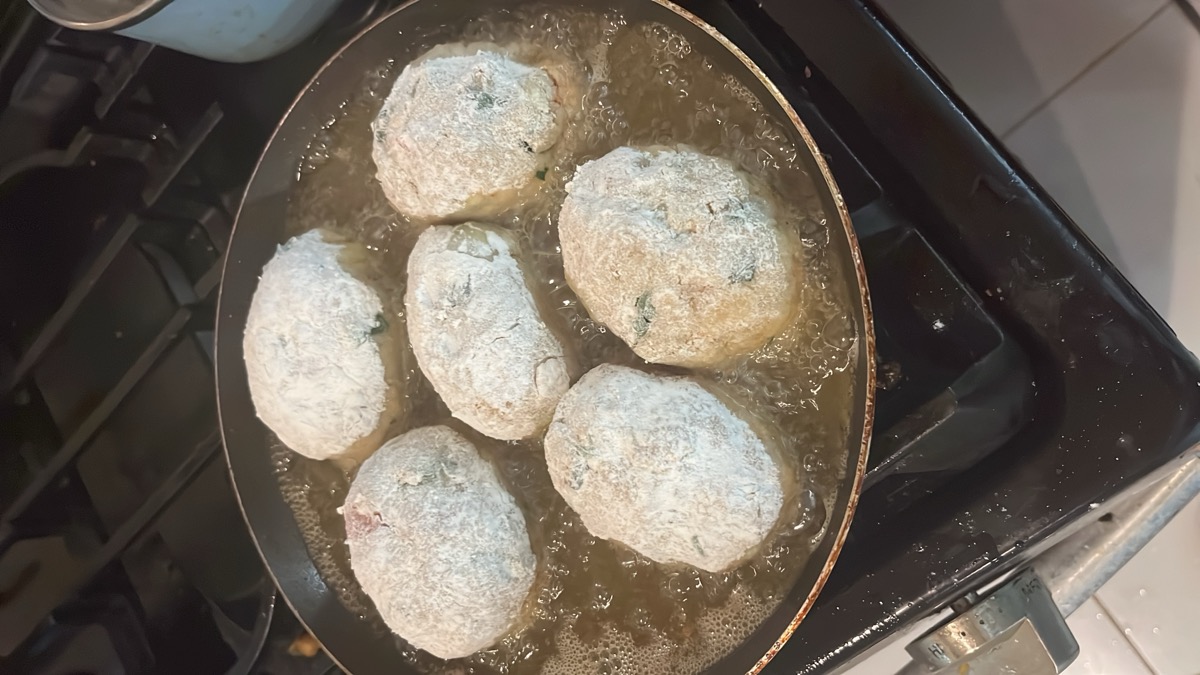
Mama's bakes, puffing in the pan — photographed in my own kitchen 💗
Golden, puffed, and gone in five minutes. Bakes don't wait for anybody, so call the family before they hit the oil.
From the Garden & Market
- 2 cups all-purpose flour
- 2 tsp baking powder
- 2 tbsp sugar
- ½ tsp salt
- 1 tbsp butter
- About ¾ cup water (or milk)
- Oil, for frying
The Way Mama Teaches
- Mix flour, baking powder, sugar and salt. Rub in the butter.
- Add water little by little into a soft dough. Knead just until smooth — don't fight it.
- Rest it 30 minutes, covered. (Yes, thirty. Go make the tea.)
- Cut pieces, roll into rounds about ¼-inch thick.
- Fry in hot oil, spooning oil over the top so they puff proud. Golden both sides, drain, serve hot.
Mama says: if the oil isn't hot enough, the bake will drink it. Test with a little piece first — always.
For my family: with cocoa tea, and with butter melting in the middle.
🍅
Italian at Heart
I'm Guyanese by birth and Italian at heart — fresh tomatoes are my love language. New York taught me this chapter at my little island kitchen, and my garden signs off on every tomato in it.
Pasta From Scratch
From scratchTwo ingredients, one miracle
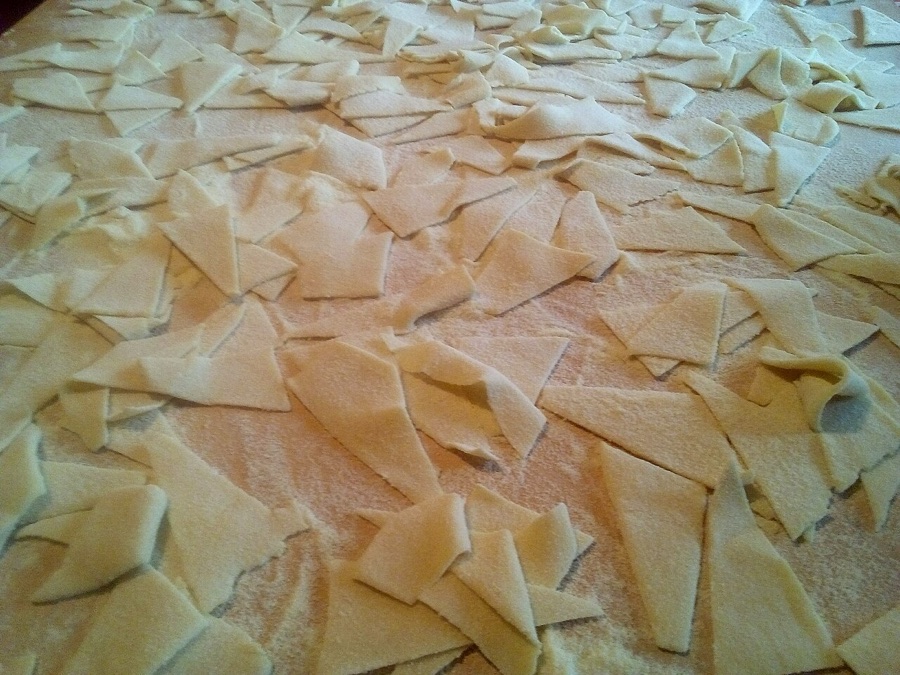
Fresh pasta on the floured counter — exactly how Sunday afternoon should look · photo: Marica Massaro, CC BY-SA 4.0 (Wikimedia Commons)
Flour, eggs and a rolling pin — that's the whole speech. New York fed me pasta in every accent, and then I learned the truth: the best plate of it starts on a floured counter, with your own two hands, half an hour before dinner.
From the Garden & Market
- 2 cups all-purpose flour, plus more for dusting
- 3 large eggs — the freshest you can find; yard eggs make golden pasta
- ½ tsp salt · 1 tsp olive oil
- A rolling pin, a sharp knife, and patience — all three mandatory
The Way Mama Teaches
- Flour on the counter, a well in the middle like a little volcano. Eggs, salt and oil into the crater.
- Fork the eggs, pulling flour in from the walls little-little till it's a shaggy mess — then hands in. This part is not neat. Good cooking rarely is.
- Knead 8–10 minutes till smooth and springy. Too dry, wet your hands; too sticky, dust more flour. The dough will tell you — listen.
- Wrap it and REST 30 minutes on the counter. The gluten needs to calm down and so do you — go set the table.
- Divide in four. Roll each piece thin enough to see the shadow of your hand through it — thinner than you think, dusting as you go.
- Flour the sheet, roll it up loose like a little carpet, and cut ribbons — a finger-width for fettuccine. Shake them open, dust, and let them air while the water boils.
- Big pot, salted like the sea. Fresh pasta cooks in 2–3 minutes — it floats up and asks to come out. Listen to it.
Mama says: the rest IS the recipe. Skip the thirty minutes and the dough will fight your rolling pin and win. Rested dough rolls like silk — same as rested people.
For my family: Sunday-afternoon ribbons drying on the counter while somebody small "helps" with the flour. 💙
Fettuccine Alfredo, Made Proper
From scratchNew York nights
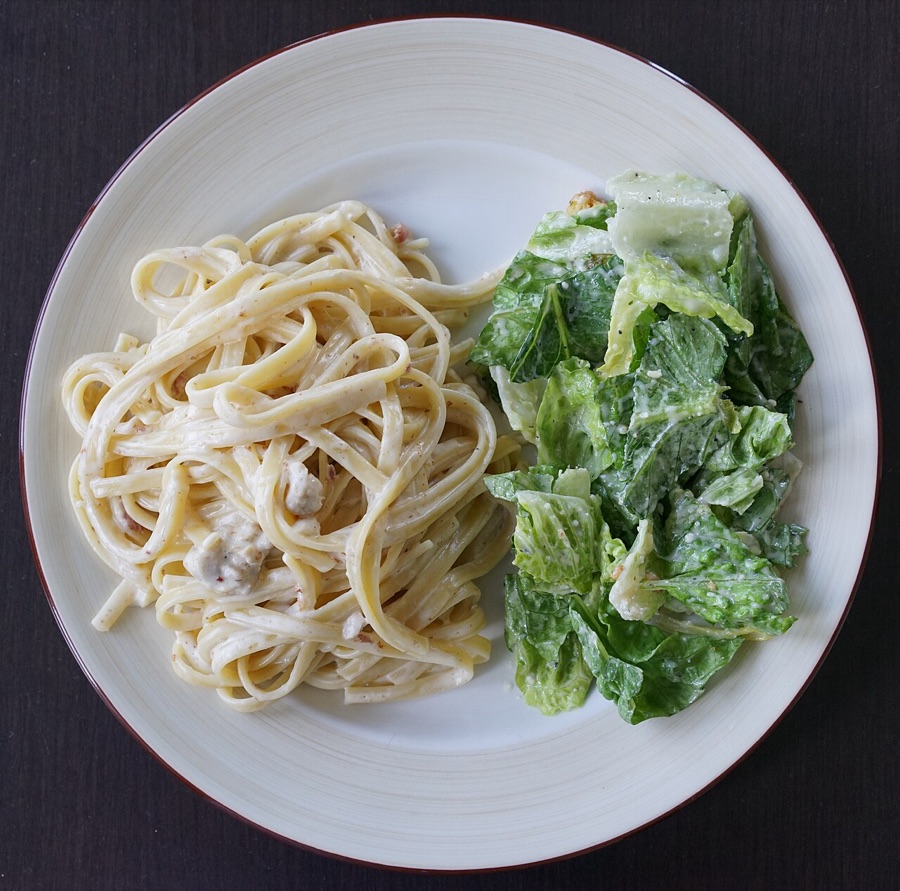
Velvet ribbons, greens standing by · photo: Dllu, CC BY-SA 4.0 (Wikimedia Commons)
Butter, cream and real parmesan, tossed with fresh fettuccine till it turns to velvet — no jar in sight, no jar EVER in sight. This is what New York evenings tasted like at my island, and it takes less time than the delivery man.
From the Garden & Market
- Fresh fettuccine from the recipe above (or 1 lb good dried)
- 6 tbsp butter · 1 cup heavy cream
- 1½ cups parmesan, finely grated — real parmesan, grated by YOU; the dusty shaker is not invited
- Black pepper, fresh · tiny pinch of nutmeg · salt
- A cup of the pasta water — do not throw it away; it's the secret
The Way Mama Teaches
- Cook the fettuccine in well-salted water — fresh takes 2–3 minutes. SAVE a cup of pasta water before draining; write it on your hand if you must.
- Meanwhile, wide pan, low fire: melt the butter, pour in the cream, and let them get to know each other 2–3 minutes. A gentle simmer, never a boil — boiled cream splits like a bad partnership.
- Pasta into the pan, fire LOW. Now the parmesan, a handful at a time, tossing between handfuls — the cheese must melt into the sauce, not land on top of it.
- Splash in pasta water till the sauce turns glossy and coats every ribbon like velvet — that starchy water is what marries cheese to cream.
- Black pepper, the whisper of nutmeg, then taste for salt — parmesan already brought its own; taste first, always.
- Serve immediately, in warm bowls. Alfredo waits for no one — the table comes to IT.
Mama says: cheese off the fire, pasta water on standby, and serve it now-now — alfredo is a live performance, not a make-ahead. Respect the curtain time.
For my family: the creamy bowl that ends homework negotiations instantly.
Mozzarella Sticks & Fresh-Tomato Marinara
From scratchGarden tomatoes 🍅

Golden outside, ropes inside — marinara reporting for duty · photo: Sdkb, CC BY-SA 4.0 (Wikimedia Commons)
Golden outside, cheese pulling into ropes inside — and beside them, the reason I say I'm Italian at heart: a marinara made from real, ripe, sun-warm tomatoes. Fresh tomatoes are my weakness the way chocolate is my weakness. The garden decides how good this sauce is; your only job is to not get in its way.
From the Garden & Market
- 1 lb mozzarella, cut into thick fingers, COLD from the fridge
- ½ cup flour · 2 eggs, beaten · 1½ cups breadcrumbs (your own dried bread ends, seasoned with herbs and a little parmesan)
- Oil, for frying
- The marinara: 6–8 ripe tomatoes — the reddest, heaviest ones in the garden
- 4 cloves garlic · 1 small onion · basil (or fine thyme) · olive oil · pinch of sugar · salt & black pepper
The Way Mama Teaches
- Marinara first: score the tomatoes, scald them one minute in boiling water, slip off the skins, and chop. Garden tomatoes will already smell like the finished recipe.
- Olive oil, garlic and onion, gentle till sweet. Tomatoes in with salt and the sugar pinch; simmer low 25–30 minutes till thick, rich and deep red. Basil at the end. Taste it — that's summer in a pot.
- Now the sticks: three plates — flour, egg, crumbs. Every finger goes flour → egg → crumbs, THEN egg → crumbs a second time. Double coat, or the cheese escapes — one-coat sticks are a lawsuit waiting to happen.
- FREEZE the coated sticks 30 minutes minimum. Cold cheese plus hot oil equals the stretch. Warm cheese plus hot oil equals a pan of regret.
- Fry in hot oil (350°F), 1–2 minutes to deep gold — small batches, quick hands, out onto paper.
- Serve hot, marinara warm beside them, and watch the cheese-pull get photographed before it gets eaten.
Mama says: the double coat and the freezer are the two commandments. Break either one and the cheese will walk out of the crumb and into the oil — and there is no appeal.
For my family: Friday-night starters at the island — pizza's opening act. 🍅
🇬🇾
The Green Land Table
The dishes that raised all of us — from scratch, from the garden, from the market, the way the grandmothers insist. Plus a little Caribbean passport at the end, because your girl has eaten her way from Georgetown to Port of Spain to Nassau. 👑
Metemgee
From scratchGuyanese classic
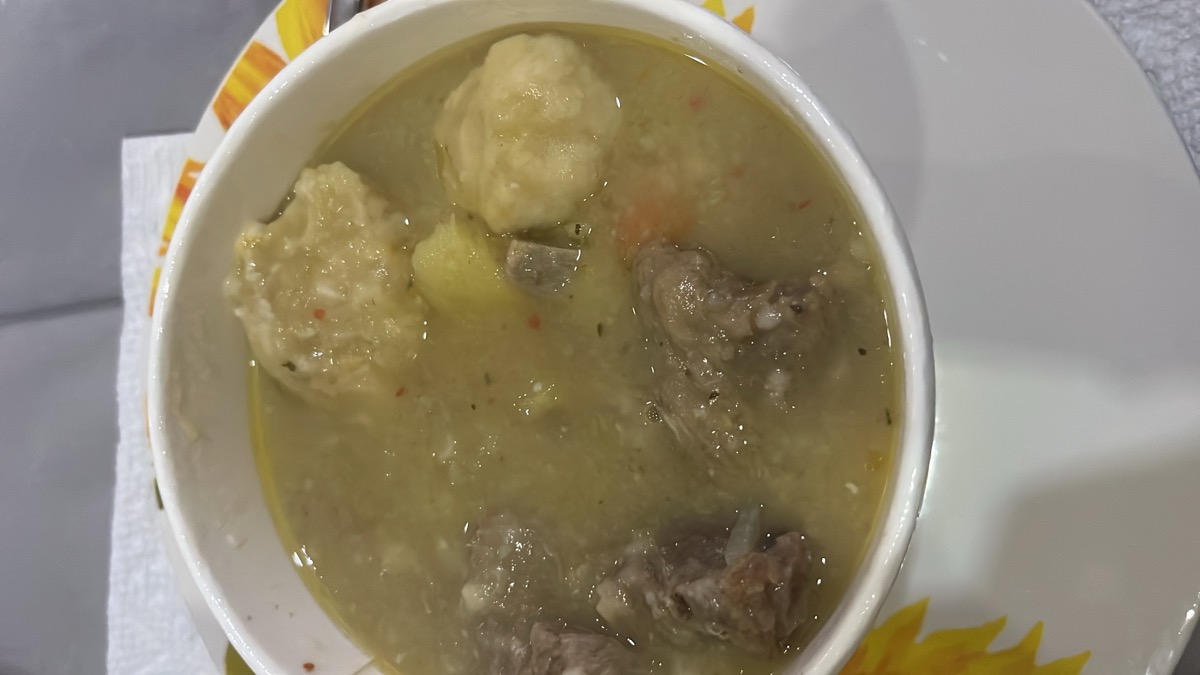
From my own pot — provisions, coconut, and duff riding on top
Ground provisions simmered in coconut milk with dumplings — "duff" — sitting on top like they own the place. This is the pot that fed generations before anybody counted a calorie, and every single thing in it came out of the ground or off a tree.
From the Garden & Market
- Cassava, eddo, sweet potato & yam — about 2 lbs all together, peeled, big chunks
- 2–3 green plantains, peeled, halved
- 1 can (or 2 cups fresh-squeezed) coconut milk + 2 cups water
- 1 onion, 3 cloves garlic, 2 stalks celery, fine-leaf thyme
- 1 wiri wiri pepper, whole — do NOT burst it
- Salt to taste · optional smoked fish or salt fish, soaked
- For the duff: 2 cups flour, 2 tsp baking powder, pinch salt, water to a soft dough
The Way Mama Teaches
- In your biggest pot, sweat the onion, garlic, celery and thyme till the kitchen starts asking questions.
- In go the provisions and plantain, hardest ones first — cassava at the bottom, it takes the longest.
- Pour the coconut milk and water just to cover. Drop the whole pepper on top like a warning. Salt it.
- Simmer gently, lid on, about 15 minutes while you make the duff: mix flour, baking powder and salt, add water little-little till you have a soft dough. Shape into fat little logs.
- Rest the duff on top of the provisions — they steam, not boil. Lid ON and no peeking for 15 minutes. Peeking lets the steam out and the duff will hold that against you.
- Everything's done when a fork slides through the cassava easy and the duff is puffed and proud. Taste, adjust salt, fish the pepper out whole.
Mama says: the pepper is a passenger, not a driver. It rides whole and comes out whole — burst it and you feeding people fire, not food.
For my family: the pot that proves the ground of Guyana loves us back.
Guyanese Chowmein
From scratchLoaded with vegetables
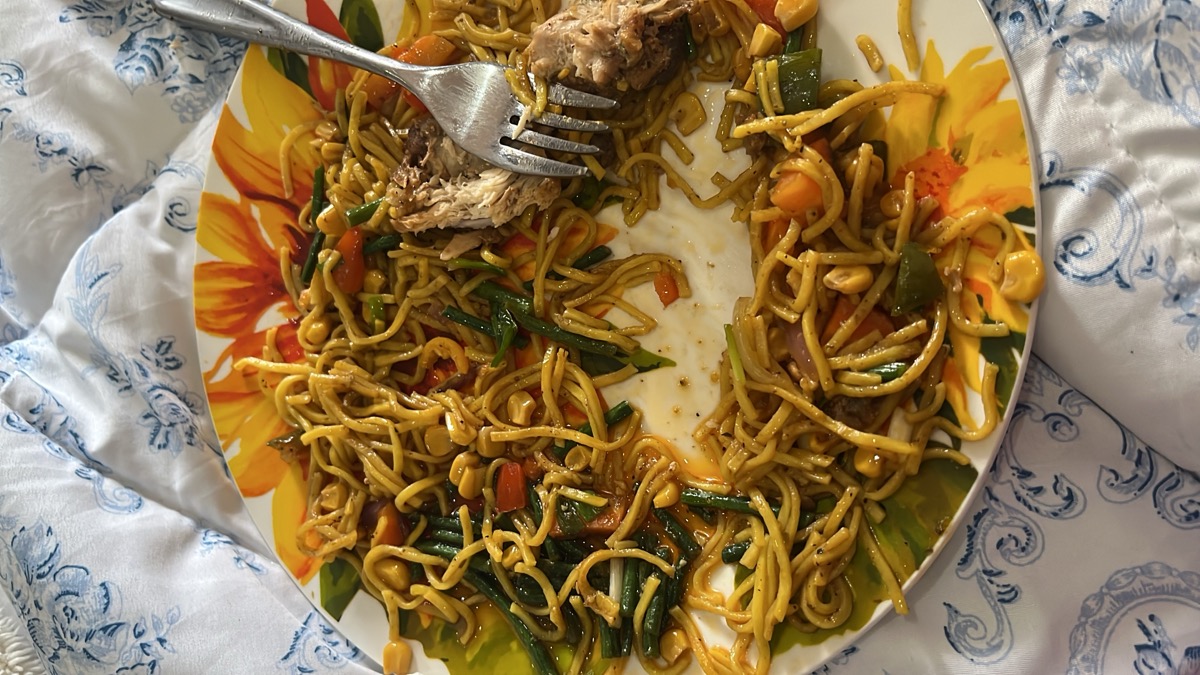
Mine — and count the vegetables before you count anything else
Our Chinese-Guyanese treasure. In this house chowmein is a vegetable delivery system — the noodles are just the excuse.
From the Garden & Market
- 1 pack chowmein noodles
- Bora (long beans), cut small · carrots, cut fine · cabbage, shredded · pak choi
- 1 onion, 4 cloves garlic, ginger — a thumb, grated
- Chicken, sliced thin & seasoned (or keep it all-vegetable, it holds its head high)
- Soy sauce, a splash of oil, black pepper, fine thyme
- Optional: a little cassareep for depth — we are Guyanese, after all
The Way Mama Teaches
- Boil the noodles two minutes less than the pack says — they finish cooking in the pot. Drain, oil them lightly so they don't hug up.
- Hot pan: sear the seasoned chicken till golden, out it comes.
- Same pan: garlic, onion, ginger — thirty seconds. Then the hard vegetables first: bora and carrot. Two minutes. Then cabbage and pak choi.
- Vegetables must stay bright and alive — the day I serve you grey cabbage, take my apron.
- Noodles back in, chicken back in, soy sauce around the edges of the pan so it sizzles — toss high and proud.
Mama says: the wok must be HOT and the vegetables must CRUNCH. Chowmein is not stew. Fast hands, high fire, bright colours.
For my family: birthday-party food, forever and always.
Chicken Curry, Sunday-Serious
From scratchGuyanese classic
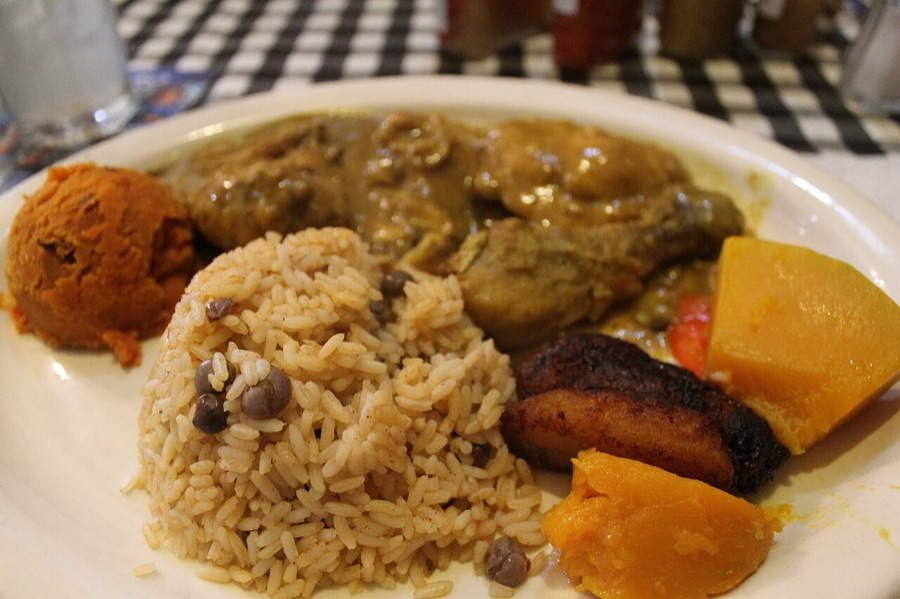
Curry doing what curry does — calling the whole street · photo: Connie Ma, CC BY-SA 2.0 (Wikimedia Commons)
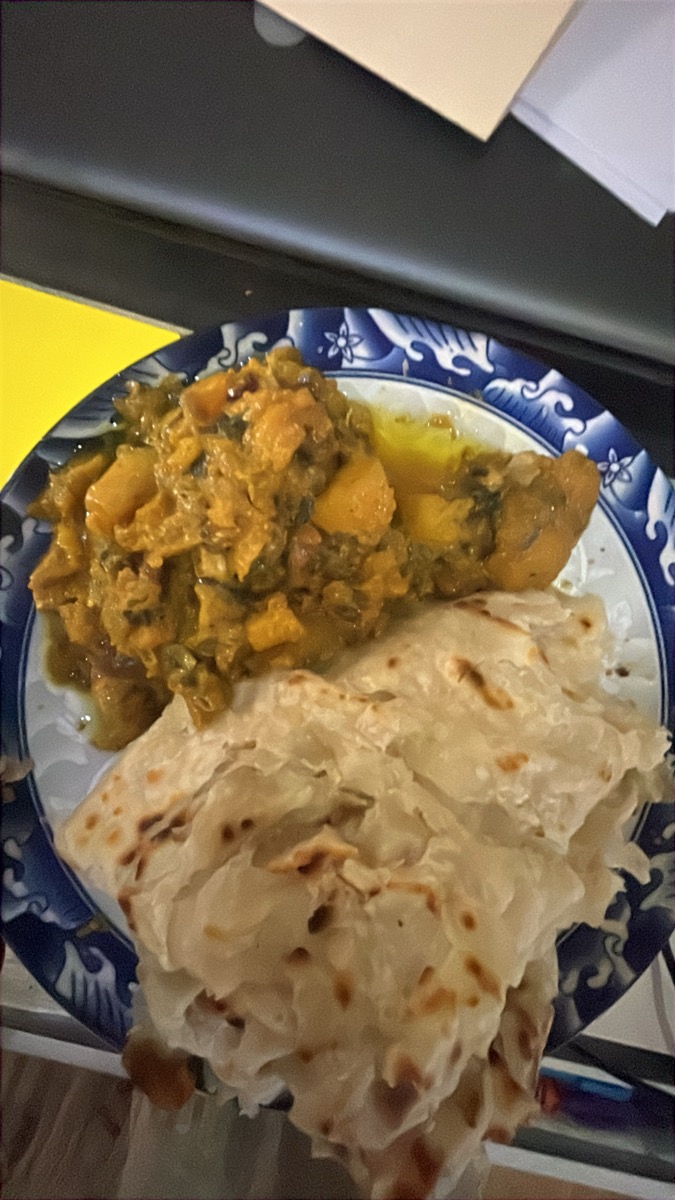
The curry that calls the whole street. My Nani's people brought this across an ocean and Guyana made it its own — and when it's Sunday-serious, the roti from Chapter 2 stands ready beside it.
From the Garden & Market
- 1 whole chicken, cut up, washed with lime
- 3 tbsp good curry powder + 1 tsp garam masala + ½ tsp geera (cumin)
- 1 onion, 5 cloves garlic, wiri wiri pepper to your courage
- Potatoes, quartered — the curry's best friends
- Fine thyme, married man pork (culantro/shado beni) if the market has it
- Coconut milk or water · salt
The Way Mama Teaches
- Season the chicken properly — curry is not a rescue mission, the flavour starts in the bowl: half the curry powder, garlic, onion, thyme, salt. Let it sit, minimum one hour.
- Make the chunkay: hot oil, the rest of the curry powder with a splash of water into a paste — fry that paste till it darkens and your neighbours forgive you for everything.
- Chicken into that glory. Bhunjay it — fry it in the curry, turning, ten good minutes. This step is the difference between curry and "curry-flavoured soup."
- Potatoes in, then liquid just to cover. Simmer till the chicken surrenders and the potatoes have drunk the gravy.
- Finish with shado beni, chopped fine. Taste. Adjust. Stand there a moment and be proud.
Mama says: the bhunjay is not optional. Fry your curry down till the oil peeks back out at you — that shine is the receipt.
For my family: Sunday, with clapped roti and no phones at the table.
Pholourie & Tamarind Sour
From scratch — real split peas
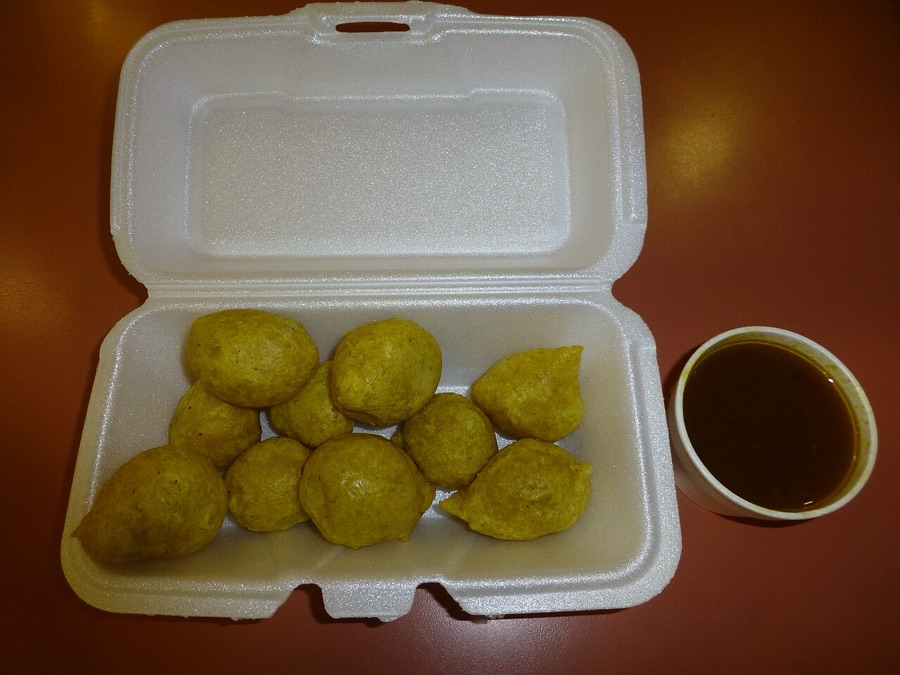
Little golden moons and their tamarind sour · photo: Grueslayer, CC BY-SA 3.0 (Wikimedia Commons)
Little golden clouds of ground split peas — and yes, from scratch, not the packet. The packet is for emergencies. We are not in an emergency.
From the Garden & Market
- 1 cup yellow split peas, soaked overnight
- ½ cup flour · 1 tsp baking powder
- 4 cloves garlic · 1 tsp geera · ½ tsp turmeric · wiri wiri to taste · salt
- For the sour: tamarind pulp, garlic, salt, a little sugar, pepper
The Way Mama Teaches
- Grind the soaked split peas with the garlic till thick and almost smooth — a blender works, a mill works better, your arm and patience work best.
- Mix in flour, baking powder, geera, turmeric, pepper, salt. The batter should drop heavy off a spoon, not pour.
- Let it rest 30 minutes — the baking powder is composing itself.
- Oil at a steady medium — test with one drop of batter: it should sink, think about life, then rise.
- Drop by the spoonful. They'll puff into little golden moons — turn them till even. Drain on paper.
- The sour: simmer tamarind pulp with water, garlic, salt, sugar and pepper till it's a bright, rude, delicious dip.
Mama says: if your pholourie come out flat, your oil was scared or your batter was lazy. Rest the batter, heat the oil, try again — we don't quit in this kitchen.
For my family: market-day treat, eaten too hot, no regrets.
Egg Balls
From scratchGuyanese classic
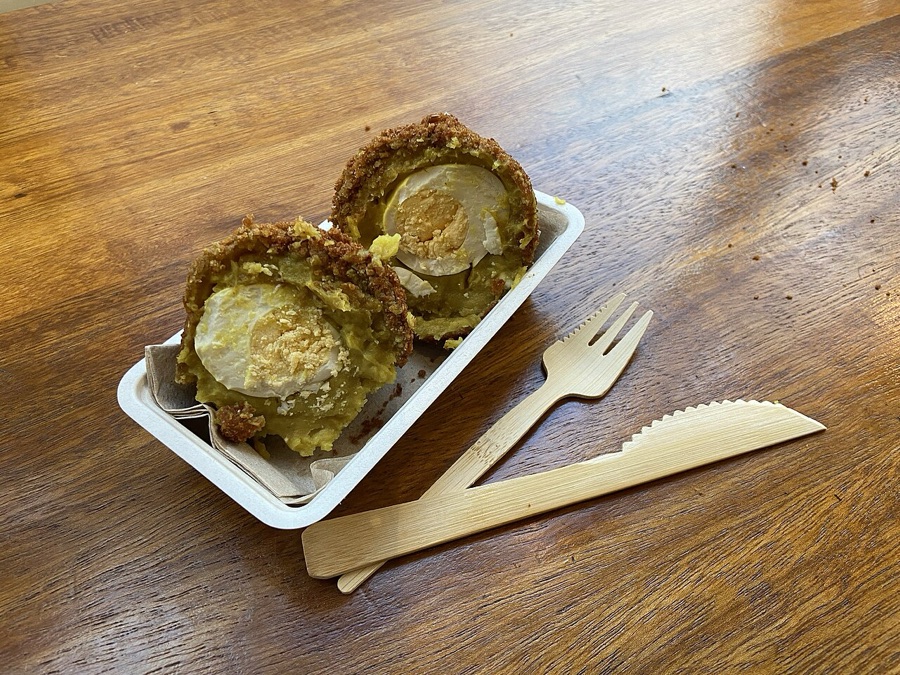
Cut one in half — the yellow-and-white middle is the whole show · photo: Sietske, CC0 (public domain dedication) (Wikimedia Commons)
A boiled egg wearing a cassava coat, fried gold. Guyana's answer to every other country's snacks — and the answer is correct.
From the Garden & Market
- 6 eggs, hard-boiled, peeled
- 2 lbs cassava, boiled soft
- Butter — a knob · 1 egg (raw, for the cassava) · salt & pepper
- Fine thyme & a little grated onion into the cassava
- Breadcrumbs (from your own dried bread ends — waste nothing)
The Way Mama Teaches
- Pound the boiled cassava smooth while warm — remove every string; the strings report directly to your critics.
- Season it: butter, salt, pepper, thyme, onion, and the raw egg to bind. It should handle like play-dough.
- Flatten a handful in your palm, sit a boiled egg in the middle, and close the coat around it — smooth, no seams.
- Roll in breadcrumbs. Fry in medium-hot oil, turning, till gold all around.
- Cut one in half for the table — that yellow-and-white middle in the golden coat is the whole show. Serve with mango sour.
Mama says: cold cassava won't pound smooth and hot cassava will burn you — warm is the word. Kitchen patience is a spiritual discipline.
For my family: the snack that disappears before it reaches the table.
Fried Ripe Plantain
Simple & wholesome
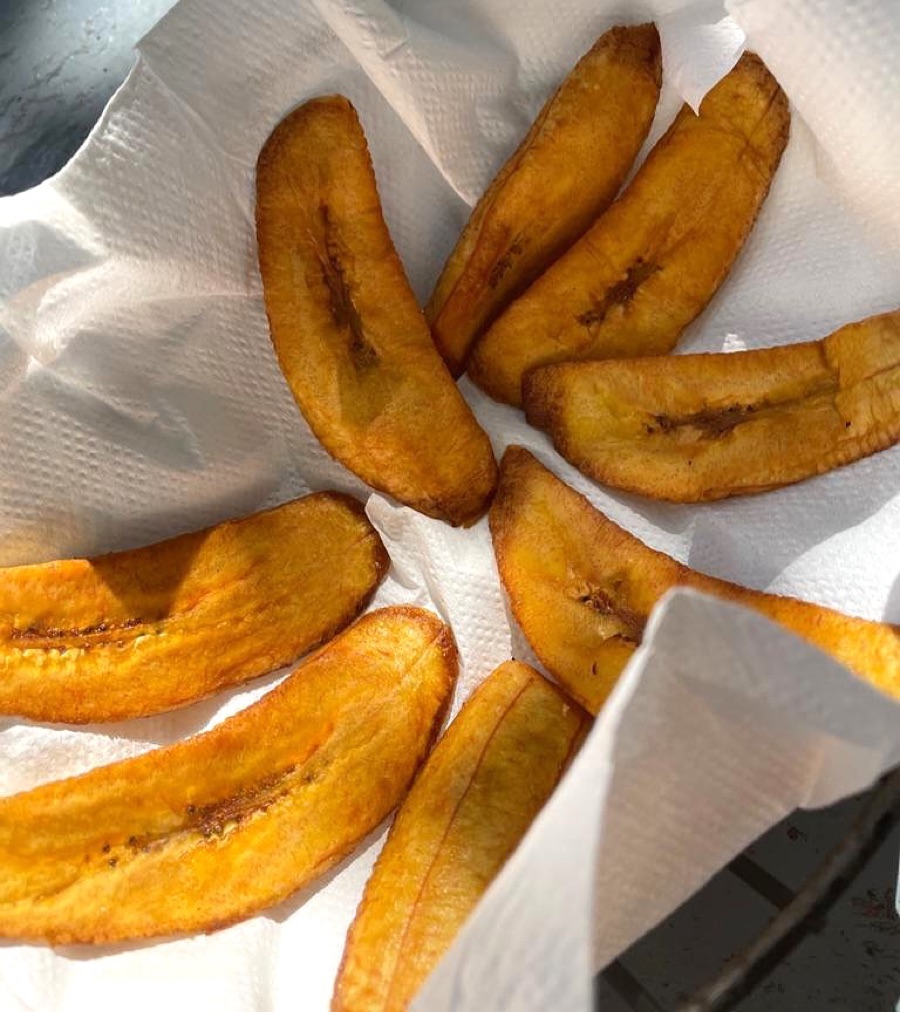
One turn, deep gold, straight from the pan · photo: Xaymacan, CC BY-SA 4.0 (Wikimedia Commons)
Three ingredients if you count the pan. The simplest thing in this whole book — and the first empty dish at every single meal. There's a lesson in that.
From the Garden & Market
- Ripe plantains — skin more black than yellow; black is not spoiled, black is READY
- A little oil or butter
- Tiny pinch of salt
The Way Mama Teaches
- Peel and slice on the diagonal, finger-thick — long slices, more golden face on each one.
- Medium heat, a little oil. Lay them in one layer — crowd the pan and they steam instead of caramelise.
- Turn ONCE, when the underside is deep gold. Two, three minutes a side.
- Whisper of salt while hot — the salt makes the sweet sing louder. That's the whole recipe.
Mama says: people beg me for this "recipe" and cannot believe it's just ripeness, patience and one turn. Most good things are.
For my family: the yellow that goes with everything — including the prince's plate. 🍌
Cassava Pone
From scratchSweetness weakness
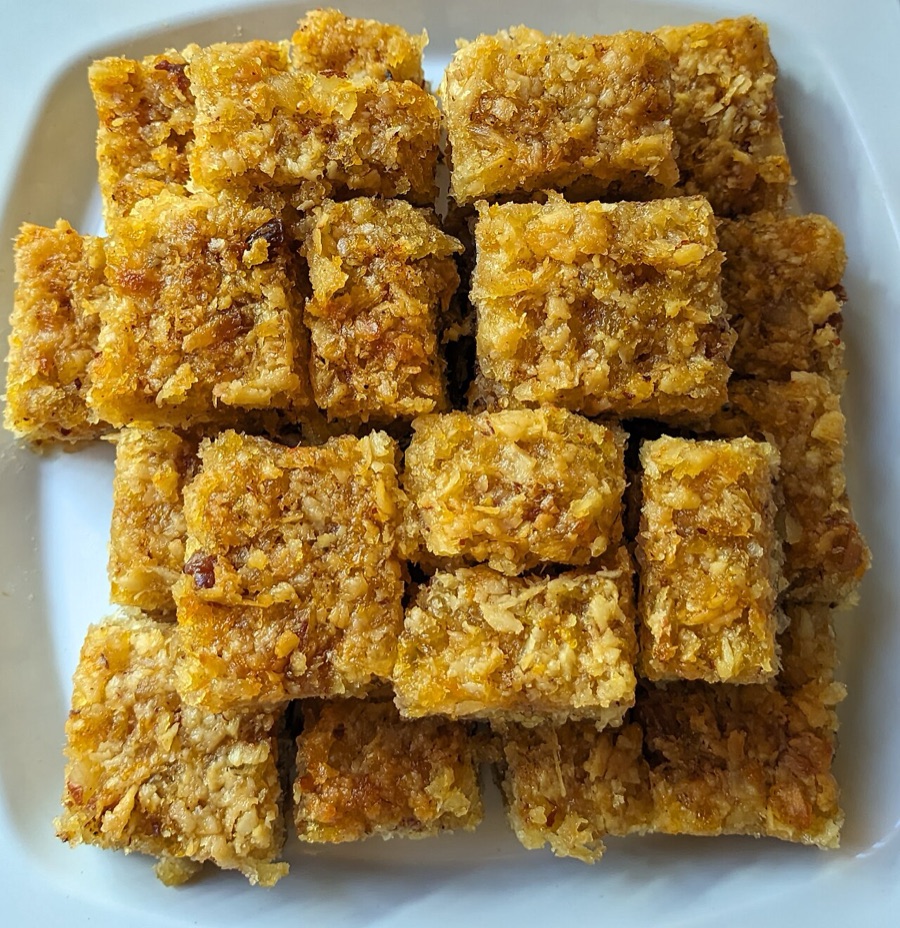
The squares — corner pieces for people who helped grate · photo: 999real, CC0 (public domain dedication) (Wikimedia Commons)
Grated cassava and coconut, baked slow into something dense, spiced and golden-edged. The corners fight-worthy. The centre negotiable. This is heritage in a baking pan.
From the Garden & Market
- 2 lbs cassava, peeled & finely grated
- 1 dry coconut, grated (or 2 cups) — fresh, we're not playing
- 1 cup sugar · 1 cup coconut milk
- 2 tbsp melted butter · 1 tsp cinnamon · ½ tsp nutmeg · ½ tsp ginger, grated
- Pinch of salt · optional: raisins (this house votes yes; your house is sovereign)
The Way Mama Teaches
- Grate the cassava and coconut fine — yes, your arm will feel it; that's the ancestors joining the recipe.
- Mix everything in one bowl. The batter should be thick but pourable — coconut milk adjusts it.
- Into a greased baking dish, no deeper than two fingers — pone is about the chewy edges, shallow wins.
- Bake at 350°F about an hour, till deep gold and a knife comes out clean-ish. The top should look like it's been to the beach.
- THE HARD PART: let it cool completely before cutting. Hot pone falls apart, and so will your reputation.
Mama says: corner pieces are for people who helped grate. House rule older than me.
For my family: wrapped in foil for every trip to Number 19, fishing days included. 🎣
Peanut Punch
Wholesome & strong

Blended smooth — and yes, that straw is pink · photo: Bedinek, CC BY-SA 4.0 (Wikimedia Commons)
The drink that raised every Guyanese athlete, scholar and hard-working daddy. Protein in a glass, blended smooth, sweetened honest.
From the Garden & Market
- 1 cup roasted peanuts (or 3 heaped tbsp natural peanut butter — just peanuts on the label)
- 2 cups milk (or oat/coconut milk)
- 1 ripe banana — nature's sweetener and thickener
- Honey or condensed milk to taste · cinnamon & nutmeg · vanilla drop
- Ice, or serve it warm like the old heads do
The Way Mama Teaches
- Blend the peanuts with half the milk first, long, till completely smooth — gritty punch is a scandal.
- Add the banana, the rest of the milk, spices and vanilla. Blend again.
- Sweeten to taste — taste FIRST; the banana already did half the work.
- Over ice, nutmeg grated on top. Hand it to somebody who's been working hard. Watch their shoulders drop.
Mama says: this is food pretending to be a drink. One glass counts as caring for yourself — doctor Spicy's orders.
For my family: after-school fuel for the prince, after-court fuel for his mama. 👑
Dhal Puri
From scratchRoti's scholarly cousin
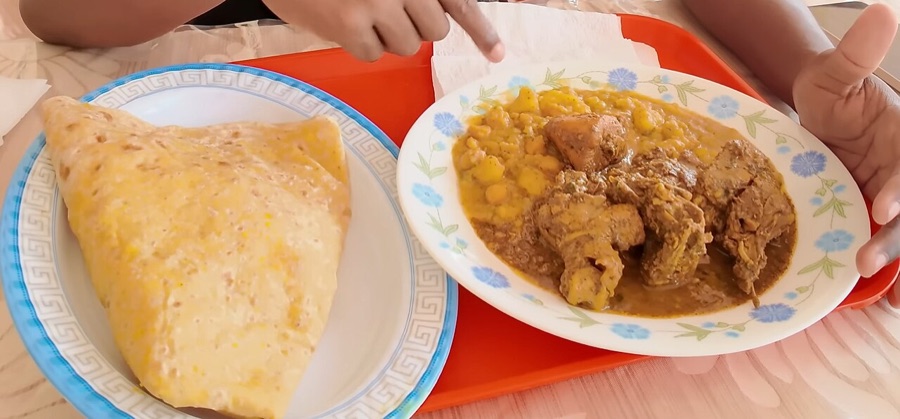
The scholarly cousin, folded beside its curry · photo: AFRICAN TIGRESS, CC BY 3.0 (Wikimedia Commons)
Roti with a secret — ground seasoned split peas hidden inside the dough, rolled thin without bursting. This is the one that separates the cooks from the legends. My Nani's people gave Guyana this treasure and we guard it jealously.
From the Garden & Market
- 4 cups flour · 2 tsp baking powder · 1 tsp salt · water for a soft dough
- The filling: 1 cup yellow split peas, boiled JUST till firm-tender (not mushy — this is the whole exam)
- 3 cloves garlic · 1 tsp geera, toasted · ½ tsp turmeric · wiri wiri to taste · salt
- Oil or ghee for cooking
The Way Mama Teaches
- Make a soft, supple dough; rest it 30 minutes under a damp cloth — rested dough forgives, tired dough tears.
- Grind the firm-boiled peas with garlic, geera, turmeric, pepper and salt into a dry, fine crumble — wet filling is how puris burst and cooks cry.
- Make dough balls; thumb a cup into each, spoon in filling generously, and pinch closed like you're keeping a secret — because you are.
- Rest again, 15 minutes. Then roll out GENTLY, even pressure, turning as you go — thin, but never thin enough to see the secret.
- On a hot tawa: cook, brush with oil, flip, brush again — blistered gold on both sides, soft everywhere.
- Stack under a clean towel. Serve with the Sunday-serious curry — dhal puri and curry is a marriage older than all of us.
Mama says: if the peas boil soft you've made dhal, not filling — firm to the bite, dry to the grind. Write it on the kitchen wall.
For my family: the roti that makes the aunties stop talking mid-sentence. That silence is the trophy. 🏆
Saltfish for the Bakes
From scratchThe bakes' soulmate
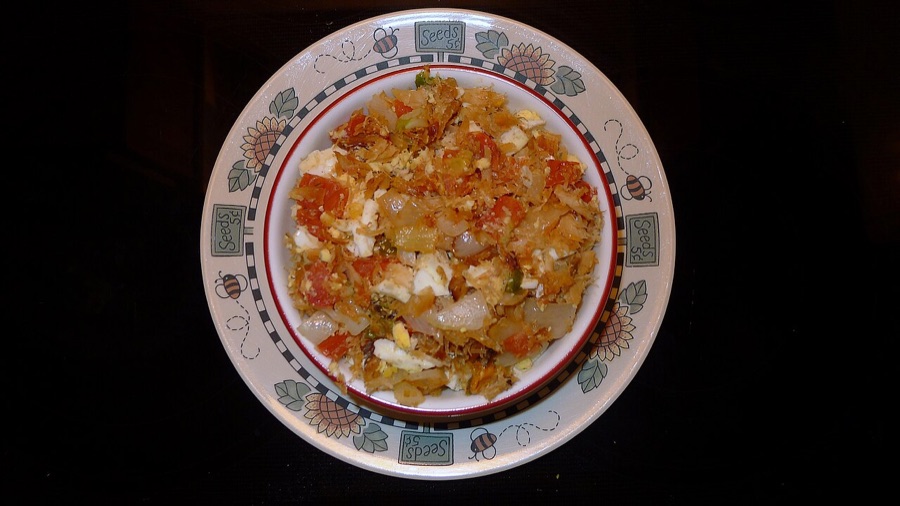
Flaked, dressed, and waiting for its bake · photo: Kalamazadkhan, CC BY-SA 4.0 (Wikimedia Commons)
Chapter One gave you the bakes. Here is what the bakes have been waiting for — flaked salted fish sautéed down with tomatoes, onion and thyme. Bakes and saltfish is not breakfast; it's a covenant.
From the Garden & Market
- 1 lb salted fish (cod or the market's best)
- 2 tomatoes, chopped · 1 big onion, sliced · 4 cloves garlic
- Fine thyme · wiri wiri or black pepper · 2 tbsp oil
- A squeeze of lime · chive to finish
The Way Mama Teaches
- Tame the salt first: boil the fish in fresh water 10 minutes, drain, taste a flake — still shouting? Boil again in new water. It should whisper, not shout.
- Cool, then flake it fine, hunting every bone like opposing counsel hunts loopholes.
- Oil in the pan: onion and garlic soft first, then tomatoes and thyme, cooked down till saucy.
- Fish in — toss and sauté 5 good minutes so every flake gets dressed. Pepper to taste. NO added salt — read the room.
- Lime squeeze and chive at the end. Split a hot bake, fill it, and understand your ancestors.
Mama says: the boil-and-taste is not optional. Salt you can't take back — a lesson the kitchen and the courtroom agree on.
For my family: Saturday morning, bakes puffing, this pan waiting. The covenant continues.
Guyanese Fried Rice
From scratchParty essential
Chowmein's rice-born sibling — dark, savoury, loaded, and the reason the rice pot from yesterday was deliberately cooked too big. Cold rice is not leftovers in this house; it's tomorrow's plan.
From the Garden & Market
- 4 cups COLD cooked rice — yesterday's, grains separate and dignified
- Chicken, seasoned & diced (or all-vegetable, stand proud)
- Bora, carrot, sweet pepper — diced small · 2 eggs
- Garlic, ginger, onion · dark soy & a touch of cassareep for our colour
- Chive & thyme · oil · black pepper
The Way Mama Teaches
- Hot pan, scramble the eggs first — out they come, waiting their turn.
- Sear the chicken golden. Garlic, ginger, onion in behind it — thirty seconds of perfume.
- Hard vegetables in, two minutes, still crunchy — the chowmein law applies across the border.
- Rice in, flame HIGH — toss, don't stir; stirring mashes, tossing blesses. Soy and cassareep around the pan's edge.
- Eggs back in, chive over top, black pepper. Every grain should be dressed in brown and moving free.
Mama says: fresh hot rice makes mush. COLD rice, HIGH fire, quick hands — fried rice is a sprint, not a stew.
For my family: the dish that ends every party discussion about what to bring. Bring this.
Wiri Wiri Pepper Sauce
From scratchHandle with respect 🔥
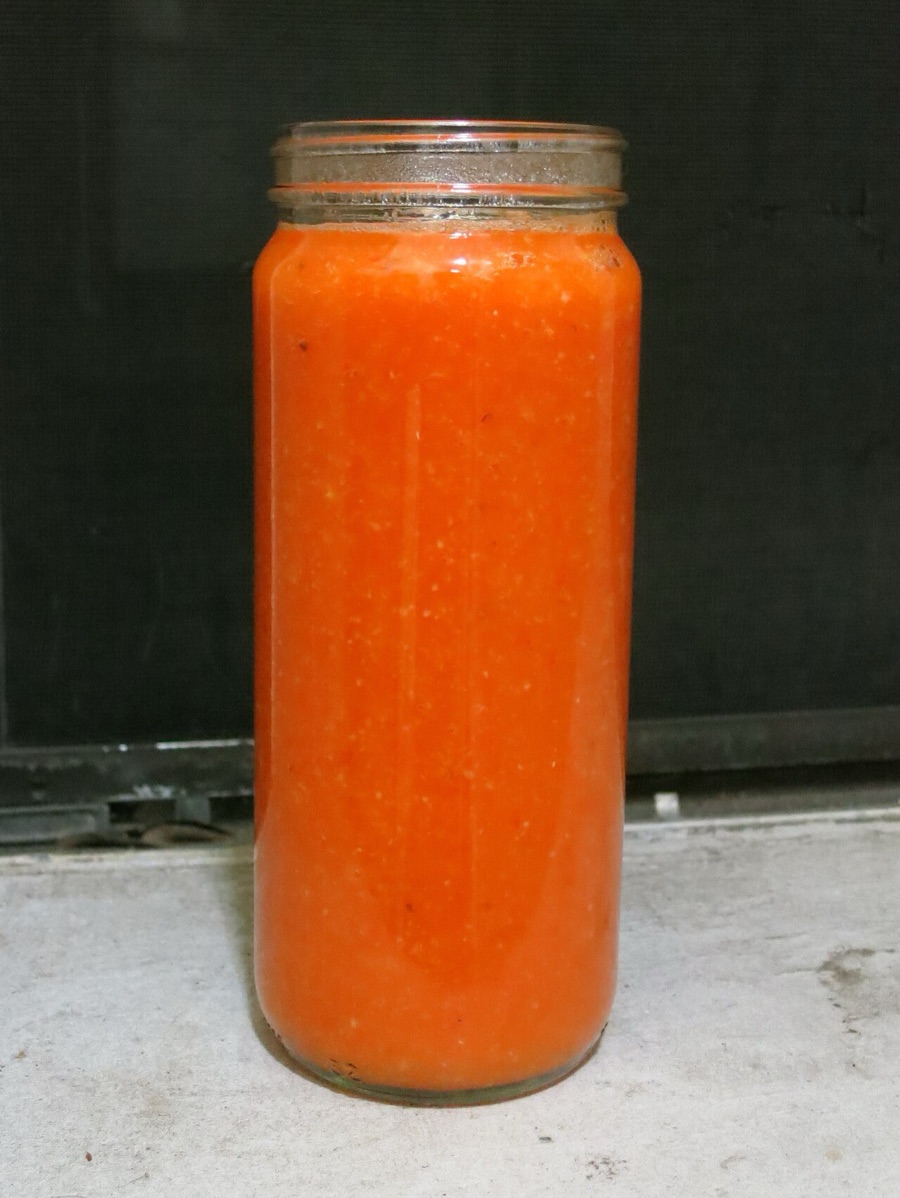
The jar in question — handle with respect · photo: mike (New York, US), CC BY-SA 2.0 (Wikimedia Commons)
The little cherry-red wiri wiri is Guyana's own pepper — fruity first, then ferocious. Every Guyanese fridge keeps a jar of this, and every family guards its ratio. Here's mine — well, most of it. 😏
From the Garden & Market
- 2 cups wiri wiri peppers, stems off
- 6 cloves garlic · 1 small onion
- 2 tbsp mustard · ½ cup white vinegar · juice of 1 lime
- 1 tsp salt · a little green mango or green papaya if you have it — the old-school body
The Way Mama Teaches
- Wash your hands AFTER, not just before — and do not touch your face, your eye, or your child until this jar is sealed. Counsel has warned you.
- Blend everything to your family's texture — some houses smooth, some houses want to see what's coming.
- Simmer gently 10 minutes — it mellows the raw edge and marries the mustard in.
- Into a CLEAN glass jar, lid tight, fridge. It only gets better with age — weeks, months, legendary.
Mama says: start with one drop on the side of the plate. Wiri wiri is sweet like a compliment and then burns like the cross-examination. Respect it.
For my family: the jar that travels to New York in suitcases, wrapped in three plastic bags and a prayer. ✈️
Mithai & Kurma
From scratchNani's sweetness
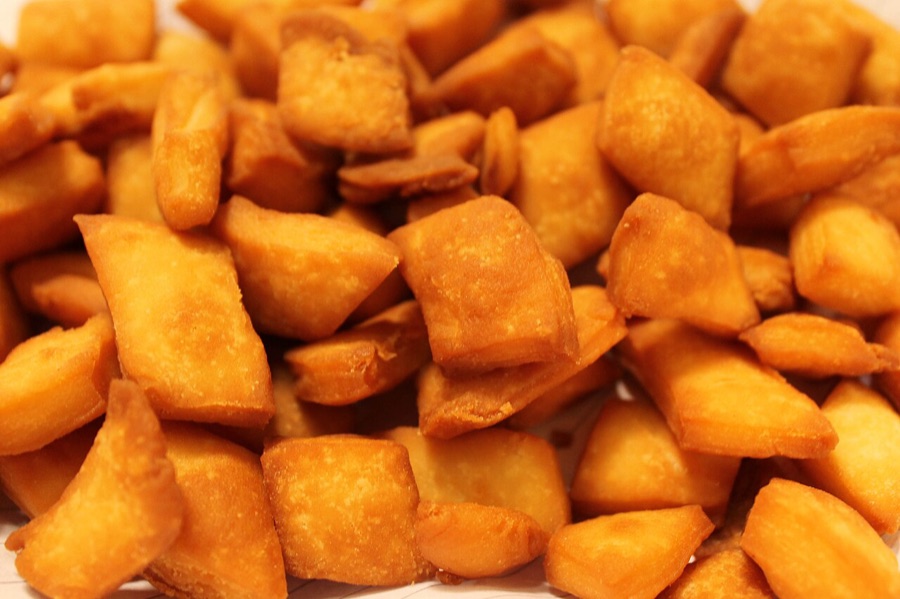
Golden fingers, ready for their ginger frost · photo: Vijay Sonar, CC BY 2.0 (Wikimedia Commons)
Golden fried dough fingers glazed in ginger sugar — kurma for every day, fat soft mithai for the holy days. This sweetness came across the ocean with my Nani's people and settled into every Guyanese childhood, mine included. Number 19 tasted like this.
From the Garden & Market
- 3 cups flour · ½ cup butter or ghee · ½ cup evaporated milk (about)
- ½ tsp cardamom (elaichi), ground — the soul of it
- Glaze: 1 cup sugar · ½ cup water · fresh ginger, grated — a fat thumb
- Oil for frying
The Way Mama Teaches
- Rub butter into flour and cardamom; add milk little-little to a firm dough — firmer than roti; kurma must hold its shape in hot oil.
- Roll thick as your finger, cut into finger-lengths.
- Fry at steady medium till deep gold and cooked through — too hot outside means raw inside, and raw inside means talk in the family.
- The glaze: boil sugar, water and ginger to one-thread stage — a drop between your fingers pulls a single thread.
- Off the fire: kurma into the pot, TOSS fast as the sugar crystallises into its white ginger frost. Work quick, with confidence — sugar smells fear.
Mama says: the ginger is not decoration — it's the argument between sweet and sharp that makes you reach for the third piece.
For my family: for Nani, who I loved across the distance — every fishing day at Number 19 ended sweet. 🤍
Mauby
Wholesome bittersThe elders' tonic
Brewed from mauby bark — bitter first, sweet after, exactly like good advice. The old heads swear by it for everything, and the old heads are usually right. It's an acquired taste that, once acquired, is never surrendered.
From the Garden & Market
- 2–3 pieces mauby bark (the market has it; ask for it by name with confidence)
- 1 cinnamon stick · 3 cloves · a piece of dried orange peel · 1 star anise if you like
- 6 cups water · sugar to taste · drop of vanilla
The Way Mama Teaches
- Boil the bark and spices in 3 cups of water for 15 minutes — the house will smell like an apothecary of ancestors.
- Cool and strain. You now hold the concentrate — dark, bitter, powerful. Respect it.
- Dilute with the remaining water, sweeten well (mauby needs real sweetness to negotiate with), vanilla drop.
- The secret of champions: pour it between two jugs, high and dramatic, till it raises a proud head of froth. The froth is not optional; the froth is the crown.
- Chill deeply. Serve over ice to somebody wise, or somebody about to become wise.
Mama says: your first glass you'll frown, your second you'll consider, your third you're one of us. Bitterness handled properly becomes character — the drink and the life lesson are the same.
For my family: what the elders reached for after big meals and bigger decisions. Pulsar Star keeps a place for it too. ⭐
🌴
A Caribbean Passport
Because your girl studied law in Trinidad and flew to the Bahamas with her parents — and came home with recipes in her heart alongside the law in her head.
Trini Callaloo
From scratchTrinidad 🇹🇹 — my law school years
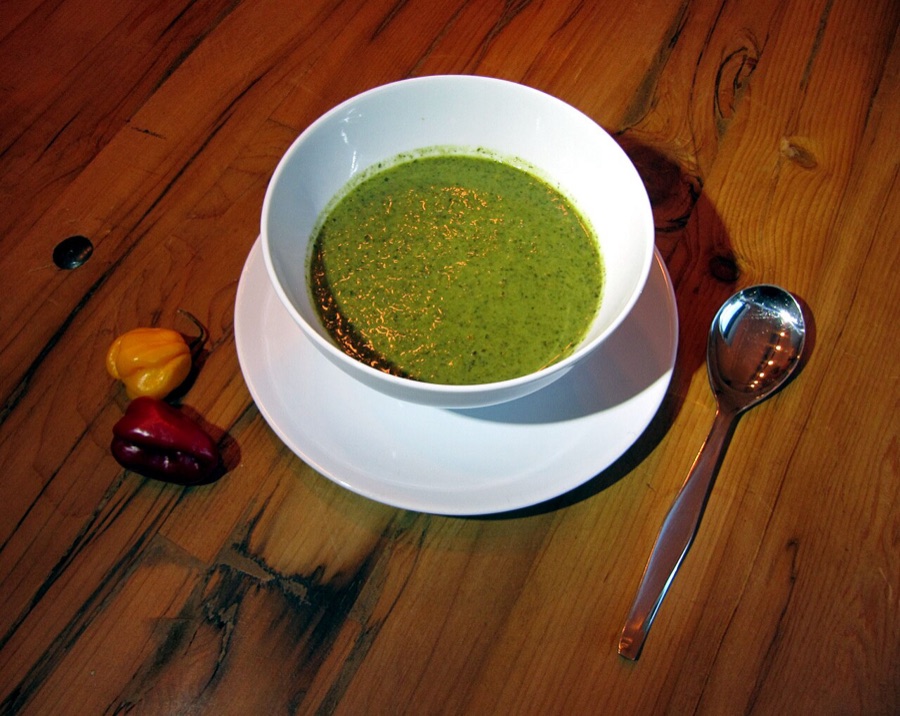
Green velvet — the peppers rode shotgun and came out whole · photo: GeoTrinity, CC BY-SA 4.0 (Wikimedia Commons)
Dasheen leaves and okra, simmered down with coconut milk into green velvet. Sunday in Trinidad smells like this — and a certain law student far from home learned that comfort has a colour, and it's green.
From the Garden & Market
- 1 bundle dasheen (taro) leaves, stripped & chopped — spinach stands in honourably
- 8 okras, sliced
- 2 cups coconut milk · 1 cup water
- 1 onion, 4 cloves garlic, chive & fine thyme, 1 whole scotch bonnet (whole! we've discussed this)
- Pumpkin, a wedge, cubed · optional crab or smoked bones, the Trini way
- Salt & a squeeze of lime at the end
The Way Mama Teaches
- Everything in the pot — leaves, okra, pumpkin, seasonings, coconut milk, the whole pepper riding shotgun.
- Simmer gently 30–40 minutes till every leaf has surrendered.
- Pepper OUT first. Then swizzle — the old wooden swizzle stick if you have it, a blender pulse if you don't — till smooth and thick as green silk.
- Salt, lime squeeze, done. Over rice, beside anything, or alone in a bowl with your thoughts.
Mama says: callaloo is proof that "eat your greens" was never meant to be a punishment.
For my family: a taste of my Hugh Wooding days — the green that got me through contract law. ⚖️
Steamed Fish & Okra
WholesomeJamaica 🇯🇲 · island-style
A whole fish steamed gently over vegetables with thyme and pimento — clean, light island cooking that treats the sea with respect. This is what "healthy" looked like before it became a hashtag.
From the Garden & Market
- 1 whole snapper (or any fresh fish looking you in the eye at the market), cleaned, scored, limed
- 8 okras · 1 carrot in sticks · 1 cho-cho (christophene), sliced
- 1 onion · garlic · fine thyme · 4 pimento (allspice) berries · scotch bonnet, whole
- 1 cup water or light fish stock · knob of butter · salt
- Water crackers on the side, island law
The Way Mama Teaches
- Season the fish inside and out — salt, garlic, thyme — and let it sit while you build its bed.
- In a wide pan: the water, onion, pimento, and the vegetables as a raft — okra, carrot, cho-cho.
- Lay the fish ON the raft — it steams, never boils. Butter on top, pepper floating whole, lid on.
- Gentle heat, 15–20 minutes, spooning the pot liquor over once or twice. The fish is done when the flesh lifts from the bone like it was only ever resting there.
- Serve fish on its vegetables with the broth spooned over — and the crackers to soak up the evidence.
Mama says: fresh fish needs almost nothing from you except restraint. Season with a light hand and steam with a low flame — the sea did the seasoning already.
For my family: island evenings — and a nod to the Bahamas trip with mommy and daddy, salt air and all. 🌊
🥖
The Guyanese Bakery
I could live inside a bakery — so I built one in my own kitchen. The glass-case classics of Guyana, baked from scratch and judged by the strictest panel I know: my own family.
Nai's Cinnamon Buns
From scratchMy signature 👑
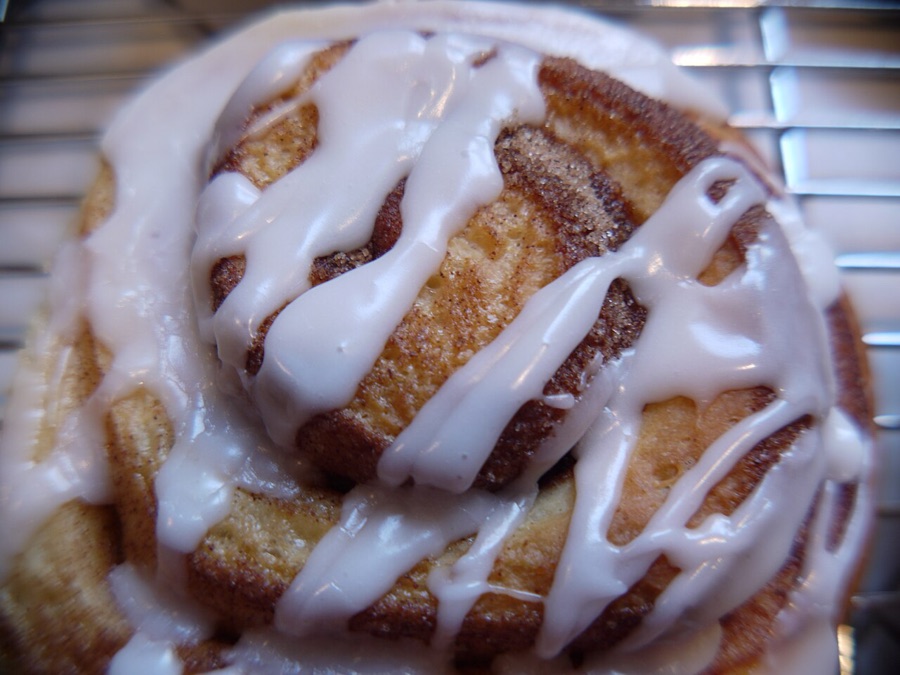
The swirl, frosted warm so it runs into the spiral · photo: grongar, CC BY 2.0 (Wikimedia Commons)
Every cook has the one thing they don't debate, and this is mine. I am really, really good at cinnamon buns — fluffy as a Sunday pillow, swirled deep, crowned with a vanilla frosting that runs into the spiral while they're still warm. On baking day the whole house smells of cinnamon before the oven door ever opens, and everybody suddenly remembers they love me. They're right to.
From the Garden & Market
- The dough: 4 cups flour · 2¼ tsp yeast · ⅓ cup sugar · 1 tsp salt
- 1 cup warm milk (baby-bath warm) · ¼ cup butter, melted · 2 eggs
- The swirl: ½ cup butter, truly soft · ¾ cup brown sugar · 2 tbsp cinnamon — real spoons, not shy pinches · tiny pinch of salt
- The vanilla frosting: 1½ cups icing sugar · 3 tbsp soft butter · 2 tsp real vanilla · 2–3 tbsp milk · pinch of salt
The Way Mama Teaches
- Wake the yeast in the warm milk with a spoon of the sugar — 10 minutes to foam; we know the drill by now.
- Flour, sugar, salt; then the milk-yeast, eggs and melted butter. Knead 10 minutes to a soft, silky, slightly lazy dough — softer than bread dough; fluffy buns are born from a dough you almost worry about.
- First rise: oiled bowl, covered, warm corner, one hour to double.
- Roll into a big rectangle, about ½-inch thick. Spread the soft butter edge to edge, then the brown sugar and cinnamon over every inch — bare corners become bland buns, and bland buns are not my name.
- Roll it up snug from the long side — firm enough to hold the spiral, gentle enough not to squeeze the softness out. Cut thick slices with a sharp knife or a loop of thread — thread cuts clean and squashes nothing.
- Lay them in a buttered dish with a little breathing room, swirl-side up. Second rise: 45 minutes, covered. They must go puffy and touch shoulders like family in a photograph. Do not rush this. I will know.
- 350°F, 22–25 minutes, to soft gold — the middles should still yield when you press. Overbaked buns are somebody else's recipe.
- The frosting while they bake: beat icing sugar, butter, vanilla — vanilla, I said what I said — milk and salt till smooth and pourable-thick.
- Frost them WARM, ten minutes out of the oven, so the vanilla runs down into the spirals and makes its home there. Then stand back and accept your applause.
Mama says: the second rise is where cinnamon buns are won or lost. Cut the forty-five minutes short and you get bread with makeup on; give the buns their full rise and they come out of the oven like clouds that learned cinnamon. Patience is the ingredient nobody writes down — so I'm writing it down.
For my family: baking-day mornings, the house full of cinnamon, small hands "checking" the frosting bowl — my signature, and one day the prince's. 👑
Butterflap & Tennis Rolls
From scratchThe bakery twins
The two soft breads of every Guyanese childhood — the butterflap folded over its butter like a love letter, and the sweet little tennis roll waiting for its slice of cheese. One soft dough, two roads, and a cup of milk tea standing by.
From the Garden & Market
- 4 cups flour · 2¼ tsp yeast · ⅓ cup sugar · 1 tsp salt · ½ tsp grated nutmeg
- 1 cup warm milk (baby-bath warm — we've discussed the yeast's feelings)
- 3 tbsp butter, soft · 1 egg
- For the tennis rolls: 1 tsp lemon essence — THE flavour; don't substitute, don't skip
- For the butterflaps: plenty more soft butter, and a little extra sugar
- Milk or beaten egg, for brushing
The Way Mama Teaches
- Wake the yeast in the warm milk with a spoon of the sugar — 10 minutes to foam. No foam, no bread; start again.
- Flour, sugar, salt, nutmeg; then milk-yeast, egg, butter and the lemon essence. Knead 10 honest minutes to a soft, smooth dough. First rise: covered, warm corner, one hour to double.
- Divide in two — one half becomes flaps, one half becomes rolls.
- BUTTERFLAPS: cut the half into balls, roll each into a thick round. Butter it shamelessly edge to edge, dust with sugar, fold in half, butter the top, and fold once more into a fat little triangle — the flap. Butter in every fold; that's the name and the law.
- TENNIS ROLLS: shape the other half into smooth round balls, tucked tight underneath, seam down, set close together on the tray so they rise up soft-sided.
- Second rise, 40 minutes. Brush with milk or egg — gently; don't deflate anybody.
- 350°F, 18–20 minutes, to soft gold — these two stay tender, never crusty. Butter over the hot tops, because we are not savages.
- Butterflap: torn open warm. Tennis roll: cooled a little, split, and a thick slice of cheese — the national pairing, non-negotiable.
Mama says: a tennis roll without cheese is a question with no answer, and a butterflap with dry corners is a confession. Butter to the edges — in baking and in life.
For my family: after-school bread, market-morning bread — the taste of being somebody's child in Guyana. 🧀
Salara — the Red Coconut Roll
From scratchBakery royalty
Soft bread spiralled around ruby-red sweet coconut — cut a slice and the swirl smiles up at you. The prettiest thing in any Guyanese bakery case, and in this house we think pink AND red.
From the Garden & Market
- Half the plait-bread dough (see the Christmas chapter — one dough, two glories)
- 2 cups fresh grated coconut · ½ cup sugar
- Red food colouring (the honest confession of every salara) · 1 tsp vanilla · ½ tsp cinnamon · tiny pinch salt
The Way Mama Teaches
- Mix coconut, sugar, vanilla, cinnamon, salt — and enough red to make it blush hard. This is salara; pale is not an option.
- Roll the risen dough into a rectangle, half-inch thick.
- Spread the red coconut edge to edge — mean it — leaving one bare inch on the far side.
- Roll it up snug from the near side, seal on the bare edge, seam down on the tray. Rest 30 minutes.
- 350°F, 25 minutes to gold. Cool BEFORE slicing — the swirl needs to set its face for the photograph.
Mama says: slice with a serious knife in one motion — sawing smears the swirl, and the swirl is the entire performance.
For my family: the red spiral that matches the roses. Beauty you can eat. 🌹
Pine Tarts
From scratchThe golden triangle
A triangle of flaky pastry with sunshine sealed inside — pineapple cooked down thick with spice. And you KNOW what pineapple means in this family: welcome, hospitality, the hotel's open door. This is welcome you can hold in one hand.
From the Garden & Market
- Pastry: 3 cups flour · 1 cup cold butter, cubed · pinch salt · 1 tbsp sugar · ice water
- Filling: 1 ripe pineapple, grated (or crushed, drained) · ½ cup sugar · 1 cinnamon stick · squeeze of lime · drop of vanilla
- 1 egg, beaten, for sealing and shine
The Way Mama Teaches
- Cook the pineapple with sugar, cinnamon and lime till THICK — jammy, no juice running anywhere. Cool it completely; hot filling murders pastry.
- Pastry: rub cold butter into flour till it looks like coarse sand with pebbles of butter still visible — those pebbles become the flakes. Ice water, just enough to gather. Chill 30 minutes.
- Roll, cut saucer-size circles. Filling in the centre — generous but governable.
- Fold in from three sides to the sacred triangle, egg-wash the seams, crimp the edges, brush the tops.
- 375°F, 25 minutes to full gold. Cool enough that the first bite teaches pleasure, not pain.
Mama says: cold butter, cold water, cool hands, cooled filling — pastry is a cold-hearted business with a warm-hearted ending.
For my family: the pineapple means welcome — from the hotel's front door to this very page. Come in. 🍍
Cheese Rolls
From scratchPine tart's savoury twin
Same flaky pastry, different soul — sharp seasoned cheese rolled into golden fingers. In every Guyanese bakery the pine tarts and cheese rolls sit side by side like siblings who secretly compete. Buy both. Bake both.
From the Garden & Market
- The pine-tart pastry (make double; you were warned)
- 2 cups sharp cheddar, grated
- 1 tbsp mustard · 1 tbsp butter, soft · black pepper · tiny pinch cayenne · chopped chive
- 1 egg for sealing & shine
The Way Mama Teaches
- Mash cheese, mustard, butter, pepper, cayenne and chive into a rough paste — taste it and try to stop; this test builds character.
- Roll pastry, cut into rectangles about the size of your hand.
- A log of filling along one edge, roll up snug, seal the seam with egg, tuck the ends.
- Seam down on the tray, egg-wash the tops, prick once with a fork — the steam needs a door.
- 375°F, 20–25 minutes to gold. The smell will summon people you haven't seen in months.
Mama says: sharp cheese or nothing — mild cheese in a cheese roll is a breach of contract.
For my family: bake sale champions, church function legends, gone in minutes every time.
Cheese Straws
From scratchThe glass-case crisp
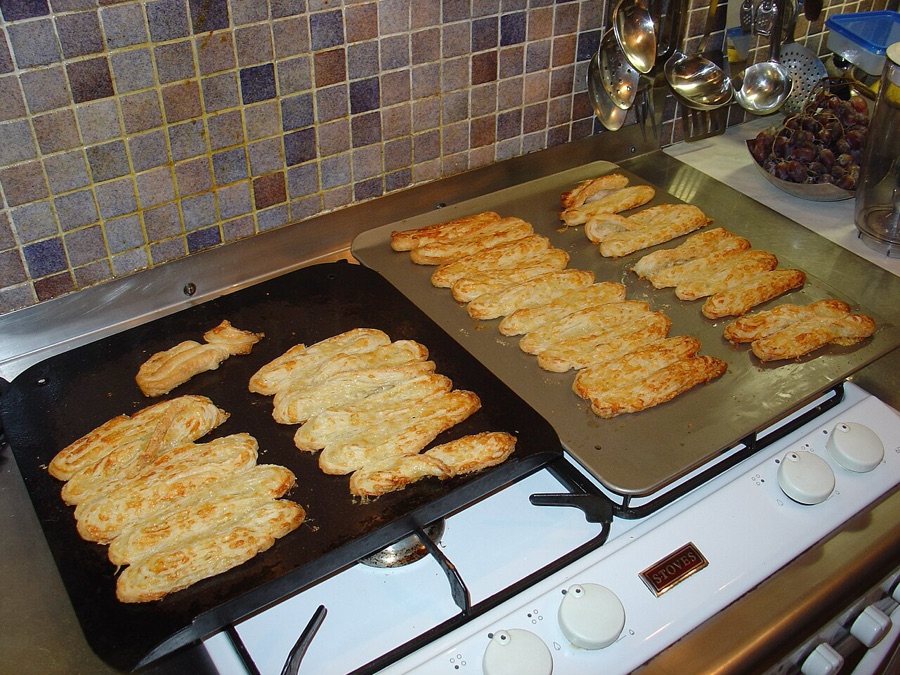
Fresh off the trays — waiting for the snap · photo: Andrew Fogg, CC BY 2.0 (Wikimedia Commons)
Golden fingers of cheese shortbread with a wiri wiri wink — crisp, rich, and never, ever enough of them. In every Guyanese bakery case they sit like a dare: buy a dozen, eat a dozen, drive home wondering what happened.
From the Garden & Market
- 2 cups flour
- 2 cups sharp cheddar, finely grated — sharp; we've been through this in this book
- ½ cup cold butter, cubed
- 1 tsp mustard · ½ tsp salt
- Wiri wiri or cayenne — a pinch, to your family's courage
- 1 egg (or a few spoons of cold milk) to bring it together
The Way Mama Teaches
- Rub the cold butter into the flour, salt and pepper till it looks like sand.
- In with the cheese and mustard; then the egg, little-little, JUST till it gathers into a firm dough. Mix like you're ending an argument, not starting one — overworked dough makes tough straws.
- Chill 20 minutes. Roll about ¼-inch thick and cut neat finger-length straws — or pipe them, if your arm is strong and your star tip is willing.
- On the tray with space between. 350°F, 15–18 minutes, till golden and smelling illegal.
- THE TEST OF CHARACTER: cool them completely on the tray — straws crisp as they cool. Hot straws bend; cooled straws snap. Wait for the snap.
Mama says: the snap is the certificate. If it bends, it needed more minutes or more patience — usually patience.
For my family: the tin that's supposed to last till Sunday and never once has.
Sponge Cake — the Saturday Classic
From scratchEvery aunty has one
The golden, essence-scented butter cake every Guyanese kitchen calls "sponge cake" — creamed pale, baked patient, sliced for whoever passes by. Every aunty swears by her own version. This one is mine, and I'm right.
From the Garden & Market
- ½ lb (2 sticks) butter, truly soft · 1½ cups sugar
- 5 eggs, room temperature
- 2½ cups flour · 2½ tsp baking powder · pinch of salt
- ½ cup evaporated milk
- 1 tsp vanilla + ½ tsp almond essence (the mixed-essence bottle is the Guyanese secret) · zest of 1 lime
The Way Mama Teaches
- Everything at room temperature — cold eggs curdle creamed butter and hurt its feelings.
- Cream the butter and sugar a FULL 5–7 minutes, till pale, fluffy and nearly white. This step is the cake; everything after is paperwork.
- Eggs one at a time, beating well after each. If it looks curdled, a spoonful of the flour restores the peace.
- Essences and zest in. Then flour, baking powder and salt in three additions, alternating with the milk, folding gently — begin and end with flour.
- Into a greased, lined tin. Smooth the top and give the tin one firm tap on the counter to evict the big bubbles.
- 350°F, 55–65 minutes — and NO oven door for the first 45; a slammed door sinks a cake and a mood. Done when the skewer comes out clean, the top is golden, and the edges pull from the tin.
- Ten minutes in the tin, then onto a rack. Slice when cool — or when the family outvotes you, which is immediately.
Mama says: cakes are won at the creaming — pale and fluffy means light and golden; rushed and yellow means dense and sorry. Set a timer and cream the whole time.
For my family: Saturday baking with the radio on — 88.5, of course — and the first slice for the smallest hands. 👑
Black Cake
From scratch — starts MONTHS earlyThe wedding & Christmas monarch
The darkest, richest cake in the Caribbean — fruits soaked for months, burnt sugar folded through, aged like something precious, because it is. Guyanese weddings are crowned with it and Christmas is incomplete without it. This recipe is a calendar, not an afternoon.
From the Garden & Market
- 1 lb mixed fruits: raisins, prunes, currants, cherries — ground or chopped fine
- Grape juice & browning for soaking (the traditional soak is spirited — this house honours both roads; choose yours)
- ½ lb butter · ½ lb sugar · 5 eggs · 2 cups flour · 2 tsp baking powder
- 1 tsp each cinnamon & nutmeg · 1 tbsp vanilla · zest of 1 lime
- Burnt sugar: ½ cup sugar, taken dark in a dry pot
The Way Mama Teaches
- Months ahead (or minimum one honest week): grind the fruits and drown them in their soak, jar sealed, dark cupboard. Shake it when you pass and whisper your plans to it.
- Burn the sugar dark — smoke's edge but never bitter-black — then cool it with a careful splash of water. This is the cake's midnight colour.
- Cream butter and sugar pale and fluffy; eggs one at a time; vanilla and zest.
- Fold in the soaked fruits and burnt sugar, then flour, baking powder and spices — batter dark as the family stories.
- Lined tin, LOW oven — 300°F — for 2 to 2½ hours. Skewer must come out clean but never dry.
- While warm, brush the top with more of the soak. Wrap and let it age at least a week — black cake, like justice, cannot be rushed.
Mama says: the fruits soaking in the cupboard is a promise you make to December in July. Keep your promises.
For my family: wedding cake, Christmas cake, the cake of covenants — future tense, and I shall rejoice in time to come. 💍
🎄
Christmas Morning in Guyana
In Berbice, Christmas doesn't begin under a tree. It begins in the dark, at the stove — when the pot that has been waiting for days is finally lifted off the fire, and the bread is torn, never cut.
Pepperpot — the National Treasure
From scratchTHE national dish 🇬🇾
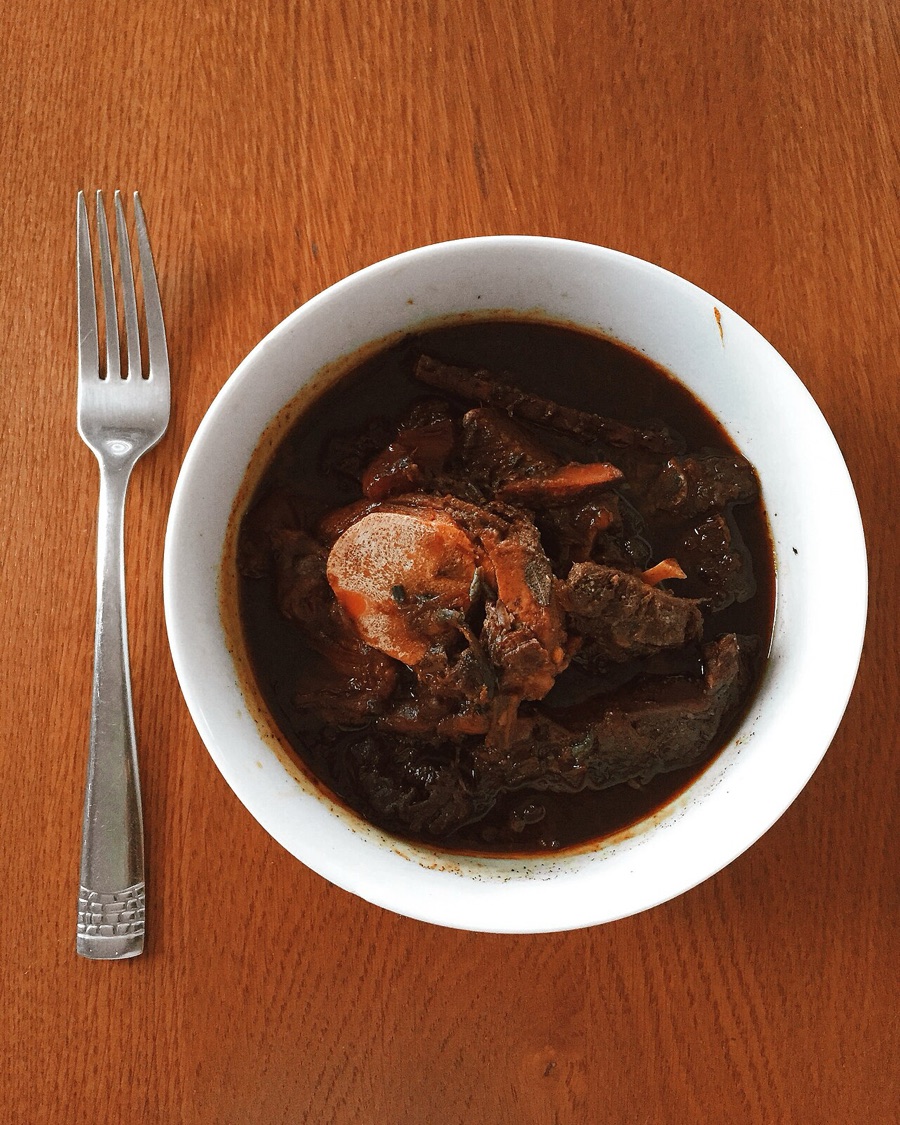
Dark as midnight, glossy as Christmas morning itself · photo: Simon Abrams, CC BY 2.0 (Wikimedia Commons)
The whole house wakes to it: cassareep and cinnamon, the dawn smell of Christmas in Berbice. Pepperpot is beef simmered black and glossy in cassava's own dark magic — the Amerindian gift that preserves the pot for days — and it is THE Christmas-morning dish of my country, eaten with plait bread torn straight from the loaf while the sky is still deciding what colour to be. This is the oldest recipe in our whole book — older than the country itself.
From the Garden & Market
- 3 lbs beef — a mix: stew beef, cow heel, oxtail (the collagen is the silk)
- 1 cup REAL cassareep — from the market, thick and black as midnight; read the bottle, it must be cassava
- 2 cinnamon sticks · 4–5 cloves · a piece of dried orange peel
- 2 wiri wiri peppers, whole · 1 onion · 4 cloves garlic · thyme
- Brown sugar, 1–2 tbsp · salt
The Way Mama Teaches
- Start the day before — Christmas Eve at the very latest; pepperpot is a pot with a history and it needs time to write it. Season the washed meat with garlic, onion, thyme and salt, and find your biggest pot — pepperpot does not cook in small vessels or small moods.
- Meat into the pot, water just to cover, and the cassareep poured over like a benediction.
- In go cinnamon, cloves, orange peel, the whole peppers, and the sugar.
- Now the only real instruction: LOW and SLOW. Two, three hours, lid ajar, until the cow heel surrenders its silk and the gravy turns dark, glossy and thick enough to hold its opinion.
- Taste — cassareep is bitter-sweet; balance with salt and a little more sugar as your family's tongue decides. Fish out the peppers whole.
- The old tradition: the pot was never refrigerated — it lived on the stove for days, boiled up faithfully morning and evening while the cassareep stood guard, deepening every day. I honour the elders AND the refrigerator: chill the pot between days, and bring it to a proper rolling boil each time you warm it. The tradition is the flavour; the boil is the law.
- Christmas morning: lift the pot off the fire, and serve with thick-torn plait bread (next recipe — this was never an accident). Let the bread do the wiping.
Mama says: pepperpot tastes better tomorrow, and better again the day after. It's the one pot in Guyana that improves with patience and reheating — like a good argument, properly rested.
For my family: the dawn pot of Berbice — lifted off the fire while the house is still in pyjamas, the whole morning smelling like every Christmas before it. 🎄
Plait Bread
From scratchThe braided crown 👑
Guyana's braided loaf — soft, golden, butter-brushed, plaited like a crown. The bread every bakery is judged by and every grandmother swears only SHE makes properly. Now you will too. And on Christmas morning it is not sliced — it is torn, warm, and dragged straight through the pepperpot's dark glossy gravy.
From the Garden & Market
- 4 cups flour · 2¼ tsp yeast · ¼ cup sugar · 1 tsp salt
- 1 cup warm milk (baby-bath warm — hot kills the yeast and the dream)
- 3 tbsp butter, soft · 1 egg
- Extra butter for brushing — this is law
The Way Mama Teaches
- Wake the yeast: warm milk, a spoon of the sugar, 10 minutes till foamy. No foam? The yeast is deceased — start over, don't negotiate.
- Flour, sugar, salt; then milk-yeast, egg and butter. Knead 10 honest minutes till smooth and springy — this is your arm workout and your therapy in one.
- First rise: oiled bowl, covered, warm corner, one hour or till doubled and full of itself.
- Divide in three, roll into ropes, and plait like you're doing your daughter's hair for church — snug but not strangled. Tuck the ends under neatly.
- Second rise on the baking sheet, 40 minutes. Brush with beaten egg for the shine.
- 350°F, 25–30 minutes to deep gold. Brush the hot crust with butter and listen — the crackle is the applause.
Mama says: the comb taught me and the dough confirmed it — there is more power in a good plait than you believe. Patience in the braiding shows in the crumb.
For my family: torn, not cut, beside the pepperpot on Christmas morning. The two were made for each other — like this book and you.
Garlic Pork
From scratch — starts days earlyChristmas classic 🎄
The Portuguese came to Guyana with vinha d'alhos in their grip, and Guyana renamed it garlic pork and gave it a seat at the Christmas table forever. Pork put down in vinegar, garlic and thyme days before Christmas — then fried gold in its own fat while the pepperpot simmers. One table, many peoples' treasures: that is how my country does Christmas.
From the Garden & Market
- 3 lbs pork shoulder with its fat, cut in neat cubes, washed with lime
- 2 whole heads of garlic (yes, heads), peeled and pounded
- 4–6 wiri wiri peppers · a big bunch of fine thyme
- 1½–2 cups white vinegar — enough to cover completely
- 1 tbsp salt · 3–4 cloves (the spice)
- One clean GLASS jar with a good lid — glass is not a suggestion
The Way Mama Teaches
- Days before Christmas — a week is love, three days is the minimum — pound the garlic, thyme, peppers and salt into a rough paste.
- Toss the pork in the paste, pack it into the glass jar, and pour vinegar to cover every piece. Nothing may peek above the vinegar — the vinegar is the preservation and the point.
- Lid tight. The old people kept the jar in a cool dark corner; I keep mine in the fridge and lose no flavour and no sleep. Turn the jar gently whenever you pass, and think about Christmas.
- Christmas morning: drain the pork well. Into a heavy pot with half a cup of water — let the water dry off, then let the pork fry gold in its OWN fat, turning. No extra oil needed if you chose your pork right.
- Fry till the edges crisp and the garlic perfume takes the whole street. Cooked right through, always — this is the one step with no shortcuts and no appeals.
- Serve hot with plait bread. The sharp vinegar-garlic beside the sweet dark pepperpot is the whole Christmas argument, settled.
Mama says: glass jar, vinegar over every single piece, and cooked right through — the marinade is a covenant, not a shortcut. Respect the three: vinegar, garlic, patience.
For my family: the Portuguese gift on our Guyanese table — proof that Christmas in Guyana was always a potluck of peoples. 🇬🇾
Ginger Beer
From scratchThe Christmas fire 🔥

Cloudy, cold, and ready to bite first and forgive after · photo: Hannah Clover, CC BY 4.0 (Wikimedia Commons)
Sorrel is the ruby, mauby is the elder, and ginger beer is the fire — the third glass of the Guyanese Christmas trinity. Fresh ginger grated till your eyes water, steeped till it bites back, sweetened till it forgives you.
From the Garden & Market
- ½ lb fresh ginger — a real hand of it, scraped and grated
- 8 cups water · juice of 2 limes
- 1–1½ cups sugar, to taste · 4 cloves · 1 cinnamon stick
- Optional, the old-school way: a few grains of rice into the brew, to help it wake up
The Way Mama Teaches
- Grate the ginger fine — this drink is only ever as brave as your grating arm.
- Boil half the water and pour it hot over the ginger, cloves and cinnamon in a big glass jar. Top up with the rest of the water once it settles.
- Cover with a clean cloth and let it stand one to two days on the counter — the old heads set the jar in the morning sun. It should smell alive and taste like it has opinions.
- Strain through fine cloth — twice, if you want it jewel-clear. Sweeten well, brighten with the lime.
- Chill it cold-cold and pour over ice. On Christmas Day it stands on the table beside the sorrel — red and gold, like the season dressed itself.
Mama says: taste before you serve — it must bite first and forgive after. If nobody's eyes widen at the first sip, next year you grate more ginger.
For my family: three glasses on the Christmas table — sorrel, mauby, ginger beer — one Guyana. 🥂